Launch & RecoveryAmazon US

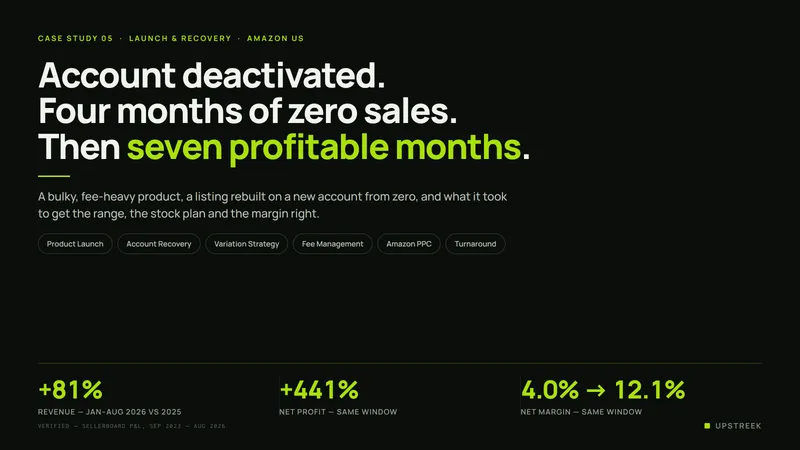
Account Deactivated. Four Months of Zero Sales. Then Seven Profitable Months.

A bulky, fee-heavy product, a listing rebuilt on a new account from zero, and what it took to get the range, the stock plan and the margin right.

Product LaunchAccount RecoveryVariation StrategyInventory PlanningFee ManagementAmazon PPC
Sammary brand cover collage of a pastry chef decorating cupcakes beside plated cakes, tarts, cookies, and other desserts.

+81%

Revenue · Jan–Aug 2026 vs the same months in 2025

+441%

Net profit · same window

4.0% → 12.1%

Net margin · same window

The starting point

We launched this brand on Amazon in September 2023, opening on a pack of 200 chosen from a variation analysis. The product is bulky and sells in multi-packs, which means the fee structure decides the outcome long before the marketing does — fulfilment alone takes 30 cents of every revenue dollar, and storage is billed whether the stock moves or not. The first four months went well: $54,679 in revenue and $7,687 in profit.

From pressure to progress

A sequence of decisions, turning points, and proof.

  1. The Challenge

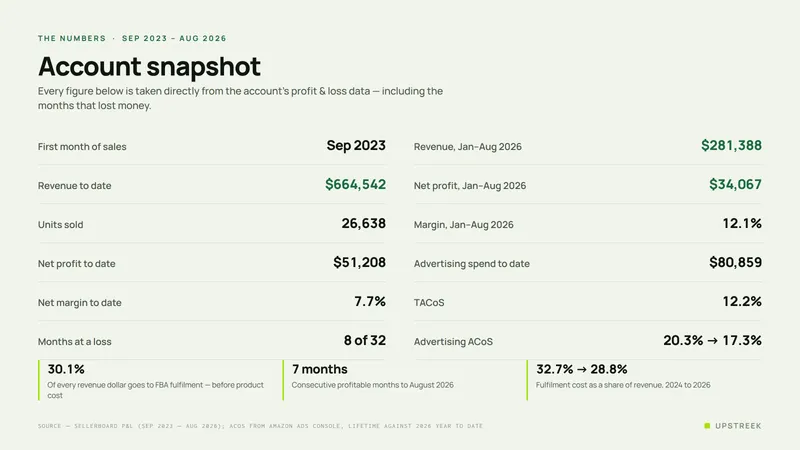
    On a product like this the margin is decided in the warehouse, not in the ad account. Across the life of the account, FBA fulfilment has taken 30.1% of revenue and the referral fee another 14.2% — $294,196 before a single dollar of product cost, advertising or storage. That leaves very little room to absorb a shift in demand, and none at all for holding stock that is not moving.

  2. Demand Moved Down the Range

    The pack of 200 sold, and then it stopped selling. Demand moved down the range — buyers shifted to packs of 100 and packs of 50, and the larger format kept turning more slowly than the inventory plan assumed. On a bulky product that is not a merchandising problem, it is a cash and storage problem: a slow pack size ties up money and warehouse space at the same time. We cleared the slow stock, rebalanced the range, and later added a pack of 150 to sit between the two sizes that were working.
  3. The Account Was Deactivated

    Then the selling account was deactivated. Nothing about the product had changed, but the listing came down and it took four months to get trading again — May through August 2024 show zero revenue and zero units. The resolution was to move the listing onto a different account and relaunch it there. Everything the original listing had built in its first year stayed behind: ranking, review velocity, advertising history.
  4. The Fourth-Quarter Storage Trap

    The second lesson arrived on a bill. Storage cost $2,862 in November 2025 and $2,961 in December, against a normal month of $400 to $800 — then $2,284 again in January 2026. In January that was 16.7% of the month’s entire revenue, and it is the single reason January is the only loss-making month of 2026. Bulky stock that arrives before the fourth quarter pays the fourth-quarter surcharge on every cubic foot.
  5. Relaunching on a New Account

    A relaunch is a launch. September 2024 through February 2025 lost money every month — six consecutive loss-making months, $6,941 down in total — while the new listing built its history from nothing, stock came back in, and the pack mix was rebalanced around what was selling now rather than what had sold in 2023. March 2025 was the first month back in profit. From there it held.
  6. Planning Stock Against the Fee Calendar

    The fix is not complicated, it just has to be deliberate. Order quantities are now set against the fee calendar as well as the demand forecast — enough stock to trade the quarter, not enough to sit through the surcharge period paying rent. Since February 2026 storage has run between $595 and $1,127 a month, on materially higher sales than the months that cost nearly $3,000.
  7. Where It Stands Now

    The account has been profitable every month since February 2026 — seven consecutive months, $35,635 in net profit at a 13.3% margin. January to August 2026 delivered $281,388 in revenue and $34,067 in profit, against $155,726 and $6,293 for the same months in 2025: revenue up 81%, profit up 441%, margin up from 4.0% to 12.1%. May 2026 was the best month the brand has had, at $51,776.
  8. The Outcome

    Three years in, the account has done $664,542 in revenue and $51,208 in net profit — a 7.7% margin that carries the deactivation and the rebuild inside it. The more useful number is the current one: a 12.1% margin across 2026 so far, on nearly twice the revenue. Fulfilment has come down from 32.7% of revenue in 2024 to 28.8%, worth roughly $11,000 a year at the present run rate.

What We Learned

Three things, all of them expensive to learn. Demand inside a variation family moves, and on a bulky product a slow-moving pack size costs you twice — in cash and in storage — so the range has to be rebalanced when the data says so, not a quarter later. An account can go down for reasons that have nothing to do with the product, so the recovery plan matters as much as the growth plan. And stock that arrives before the fourth quarter pays the fourth-quarter surcharge: the order calendar matters as much as the order quantity.
Performance visuals

Case study cover slide for an anonymised bulky multi-pack consumer brand showing revenue up 81%, net profit up 441% and margin up from 4.0% to 12.1% year on year.
Account snapshot showing first sales September 2023, $664,542 revenue, 26,638 units, $51,208 net profit at a 7.7% margin, eight loss-making months out of thirty-two, and $281,388 revenue in 2026 to August.

Is your margin disappearing into fees?

On a bulky or low-price product, whether a listing is profitable is usually decided before the first ad runs — in the pack size, the carton dimensions and the month the stock lands. Send us the account and we will tell you honestly where the money is going.