Launch, Scale & FlipAmazon US

Three Variations. One Six-Figure Exit.

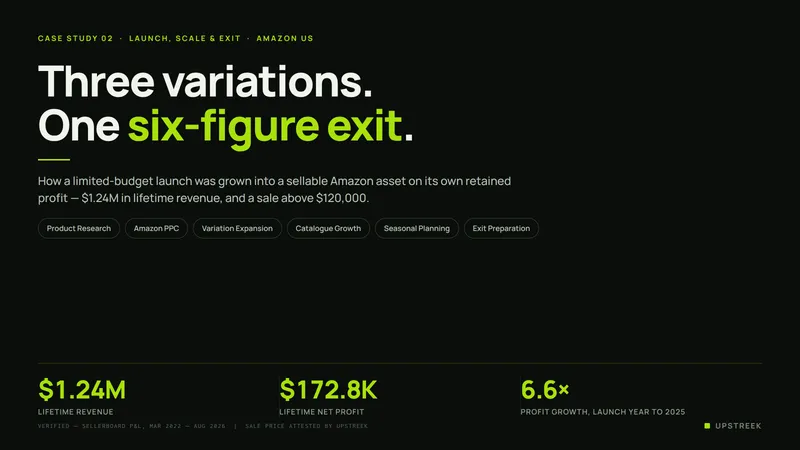
Three variations on a limited budget, grown on retained profit — sold for $120,000+ with $1.24M lifetime revenue.

Product ResearchAmazon PPCVariation ExpansionExit Preparation
Pinailer brand cover collage of hitch pins in use with truck and boat, off-road Jeep and tractor scenes.

$120,000+

Brand exit · sold in early 2026

$1,242,923

Lifetime Amazon revenue · Mar 2022 – Aug 2026

6.6×

Net profit growth · launch year to 2025

The starting point

The client had a budget and no product. We researched the category and put forward an outdoor automotive accessory — an unglamorous, high-repeat item with a clear seasonal shape: demand builds from April, holds through October, then falls away. The budget only covered a narrow launch, so we opened with three variations rather than a range. The question was never really whether the product could sell. It was whether a small, seasonal, single-listing business could be grown into something worth buying.

From pressure to progress

A sequence of decisions, turning points, and proof.

  1. The Limited-Budget Challenge

    Three variations is a thin base. It concentrates every risk in one listing — one stockout, one ranking slip, one competitor undercut, and the whole business moves. There was no capital for a broad catalogue, no second product to fall back on, and a category that gives back roughly 40% of its revenue every winter. Growth had to be funded by the product itself, which made the first year’s job simple: be profitable enough to pay for your own expansion.

  2. Reinvesting Instead of Withdrawing

    The launch was profitable almost immediately — $59,475 in revenue and $8,641 in net profit across ten months of 2022, at a 14.5% margin. The client agreed not to take that money out. Every dollar went back into inventory, new variations and advertising. That single decision is why the brand compounded: revenue roughly doubled in each of the next three years, from $59K to $129K to $246K to $467K, without significant new capital from the client.
  3. Expanding the Product Family

    The product had unusual variation potential — it worked in different shapes, colours and pack quantities. We expanded the original three variations across a second shape first, then added pack counts, then further shapes and colours. As the catalogue widened, the business stopped depending on a single listing: the one original best-seller became three strong performers. A shopper who did not want one shape, colour or pack count now had another option inside the same family.
  4. Trading a Seasonal Category

    This category gives back a large share of its revenue every winter. Across 2023–2025 the brand averaged $28,103 a month in revenue from April to October, against $16,795 from November to March — a 40% drop. Profit falls harder: $4,140 a month in season against $1,592 out of it, down 62%. The pattern repeated every year within twelve points, which made it plannable. Inventory, advertising and cash were scheduled around the curve rather than reacting to it.
  5. Profit, Quarter After Quarter

    The profit curve tells this better than any narrative. Q2 2022 returned $3,318. The same quarter returned $5,933 in 2023, $12,960 in 2024, $18,452 in 2025 and $25,938 in 2026 — 7.8× across four years. Annual net profit went from $8,641 in the launch year to $57,252 in 2025, a 6.6× rise, and the first eight months of 2026 have already booked $53,294 against $57,252 for all of 2025.
  6. Built to Be Sold

    Once the catalogue diversified, the brand was managed as an asset rather than as monthly income. That meant sales that did not depend on one ASIN, an advertising account with documented structure and repeatable rules, seasonal forecasting a buyer could rely on, and processes someone else could actually take over. In early 2026 the brand was sold to an acquiring company for more than $120,000 — built from a limited launch budget and, after that, its own retained earnings.
  7. The Post-Acquisition Partnership

    We spent about a month handing over processes, systems and account history, and the new ownership team ran the business independently from there. Advertising, though, carries years of accumulated decisions that are difficult to transfer in weeks — which structures were tested, what was ruled out, why particular terms are negatived. The acquiring company kept ownership, sourcing and supply chain, and brought us back as the specialist PPC partner. Continuity of the advertising account, without a change of owner.
  8. The Outcome

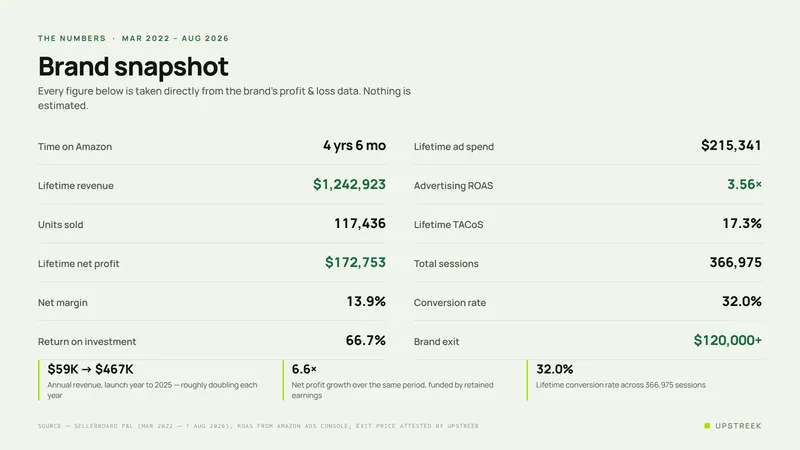
    Over four and a half years the brand generated $1,242,923 in revenue, 117,436 units and $172,753 in net profit at a 13.9% margin and 66.7% return on investment, on $215,341 of advertising returning 3.56× in attributed sales. Three variations became a family across three strong listings. The client exited above $120,000 having contributed a limited launch budget and, after that, only the product’s own profit. We still run the advertising.

We came with a limited budget and three variations. Upstreek reinvested every dollar we made, grew the brand to a six-figure exit, and still runs the advertising today.

Founder

Automotive brand

What We Learned

A limited budget is a constraint on speed, not on ceiling — if the first product is genuinely profitable, retained earnings can fund everything that follows. Product versatility is what makes that possible: shapes, colours and pack counts open new customers without a new product launch. And a brand is worth more when it is built to be handed over — diversified listings, documented advertising, forecastable seasonality. The asset is the system, not the SKU.
Performance visuals

Case study cover slide for an anonymised outdoor automotive accessories brand showing $1.24M lifetime revenue, $172.8K lifetime net profit and 6.6x profit growth from launch year to 2025.
Brand snapshot table showing 4 years 6 months on Amazon, $1,242,923 lifetime revenue, 117,436 units, $172,753 net profit, 13.9% margin, 66.7% ROI, $215,341 ad spend, 3.56x ROAS, 17.3% TACoS, 366,975 sessions, 32.0% conversion and a $120,000+ exit.

Building a brand you intend to sell one day?

The value is in the system, not the SKU — diversified listings, documented advertising, seasonality you can forecast. We build brands that way from the start, and we tend to still be useful after the sale.