New Channel LaunchAmazon US

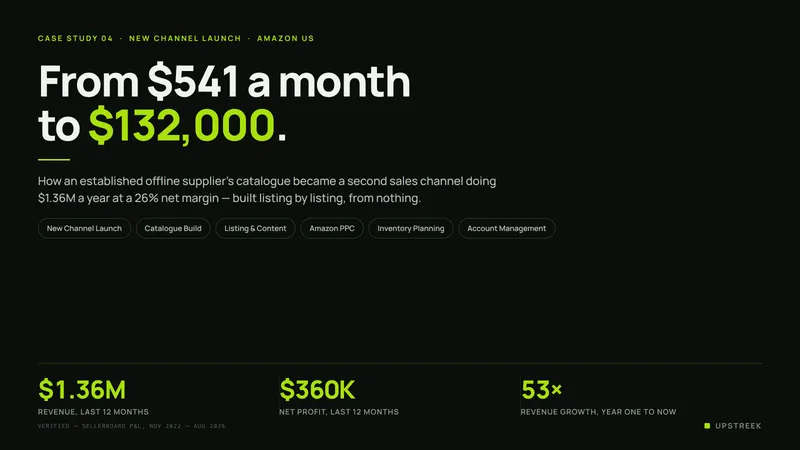
From $541 a Month to $132,000.

How an established offline supplier’s catalogue became a second sales channel doing $1.36M a year at a 26% net margin — built listing by listing, from nothing.

New Channel LaunchCatalogue BuildListing & ContentAmazon PPCInventory PlanningAccount Management
State Tools brand cover collage of green industrial pipe-bending, lifting, and hydraulic press machinery on a factory floor.

$1,363,644

Revenue · last 12 months (Sep 2025 – Aug 2026)

$360,207

Net profit · same 12 months, at a 26.4% margin

53×

Revenue growth · year one against the last 12 months

The starting point

The client had a working business and no Amazon presence. Their range sold through offline trade channels — a long-established supplier with real customers, real stock and a catalogue built up over years. We pitched a second channel: put the range on Amazon and let it reach buyers the offline business was never going to see. They agreed. The first listing went live in November 2022 and took $541 that month.

From pressure to progress

A sequence of decisions, turning points, and proof.

  1. The Challenge

    Everything had to be built. No Amazon sales history, no reviews, no ranking, no listings — and a catalogue large enough that simply getting it online was a project rather than an afternoon. The goods are bulky, which makes every stock decision more expensive to get wrong. And an offline range does not arrive Amazon-ready: titles, content, images and specification detail all had to be created before a single product could compete for a click.

  2. Listing a Catalogue, Product by Product

    There was no shortcut available. We worked through the range one product at a time — building each listing, writing the content, producing the images, getting it live, then moving to the next. It is unglamorous work and it is the reason the account exists at all. A catalogue this size cannot be launched in a single push. It gets built, and then each line gets improved once there is real search and sales data to improve it with.
  3. Advertising Across a Wide Catalogue

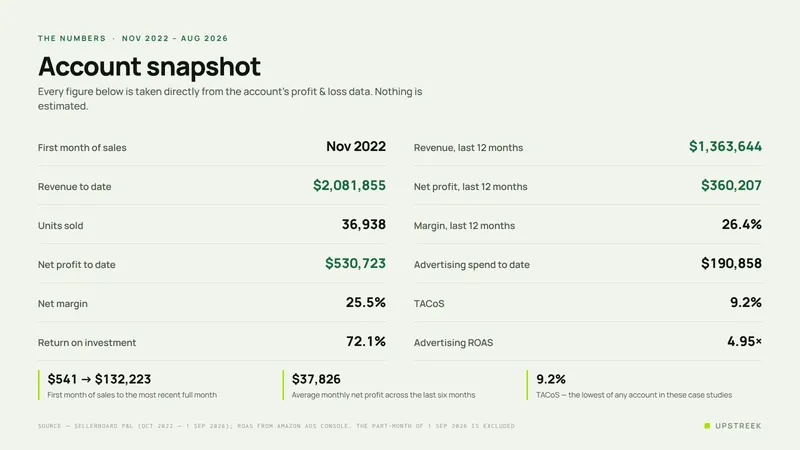
    Spreading advertising across a large range usually costs efficiency — more SKUs, more campaigns, thinner data on each one. Here it went the other way. Spend grew from under $4,200 in the first full year to $89,210 across eight months of 2026, and the return per dollar improved rather than decayed: ROAS is 4.95× to date and 5.48× in 2026, with total advertising running at just 9.2% of all revenue.
  4. Keeping Stock Ahead of Demand

    With bulky goods a stockout is not simply lost sales. It is lost ranking on a listing that took months to build, and restocking is slow and expensive. Inventory was tracked line by line and reordered against real sales velocity rather than a fixed calendar, so the listings that were working kept working. A catalogue only compounds if the products that are selling stay available to sell.
  5. The Slow First Year

    The first twelve months returned $25,761 in revenue and $6,210 in profit — an average of $2,147 a month. That is the point most sellers quit at. But the margin was already healthy at 24.1%, which said the economics worked and the missing ingredient was volume, not viability. So we kept listing, kept feeding advertising data back into the listings, and let the account accumulate the history Amazon wants before it will show a new seller to anyone.
  6. The Inflection Point

    Around late 2024 the curve changed shape. Quarterly revenue went from $55,778 in Q3 2024 to $97,622 in Q4, then $127,804, $197,087 and $204,928 through 2025. Enough listings had accumulated enough history for the catalogue to start behaving like a catalogue rather than a collection of separate products — and the account stopped depending on any single listing to carry it.
  7. Where It Stands Now

    Across the last six months the account has averaged $131,049 a month in revenue and $37,826 a month in net profit at a 28.9% margin — with net profit landing between $34,000 and $42,000 in every one of those six months. The most recent full month, August 2026, did $132,223. The last twelve months total $1,363,644 in revenue and $360,207 in net profit.
  8. The Outcome

    A channel that did not exist four years ago has produced $2,081,855 in revenue and $530,723 in net profit, at a 25.5% margin and a 72.1% return on investment, on $190,858 of advertising. Measured year one against the last twelve months, revenue is 53× higher and net profit 58× — at a slightly better margin than the first year, not a worse one. The target for the end of next year is $3M in annual revenue.

What We Learned

Three things. A catalogue is built, not launched — the work is one listing at a time and there is no version of it that is quick. A slow first year is not a failed year if the unit economics are already right; volume is by far the easier problem to solve. And with bulky goods, availability is the growth strategy: every stockout costs ranking that took months to earn and weeks to win back.
Performance visuals

Case study cover slide for an anonymised offline supplier new to Amazon, showing growth from $541 in the first month of sales to $132,000, with $1.36M revenue and $360K net profit in the last twelve months.
Account snapshot showing first sales in November 2022, $2,081,855 revenue to date, 36,938 units, $530,723 net profit at a 25.5% margin, and $1,363,644 revenue in the last twelve months.

Selling everywhere except Amazon?

If your range already sells offline, the demand is usually there. What is missing is the catalogue work and the patience to get through a first year that looks like nothing is happening. We do both.