Takeover & ScaleAmazon US

Revenue Doubled. Profit Tripled.

We took over an established single-SKU account, rebuilt its advertising and its listing, and grew it into a diversified Amazon business — $3.5M in revenue under management, and a 2026 that beat all of 2025 in eight months.

Account TakeoverAmazon PPCSearch-Term HarvestingListing & CreativeVariation ExpansionNew Product DevelopmentPortfolio Diversification
Blue Shoe Covers brand cover of PPE and protective gear in medical, painting and commercial cleaning settings.

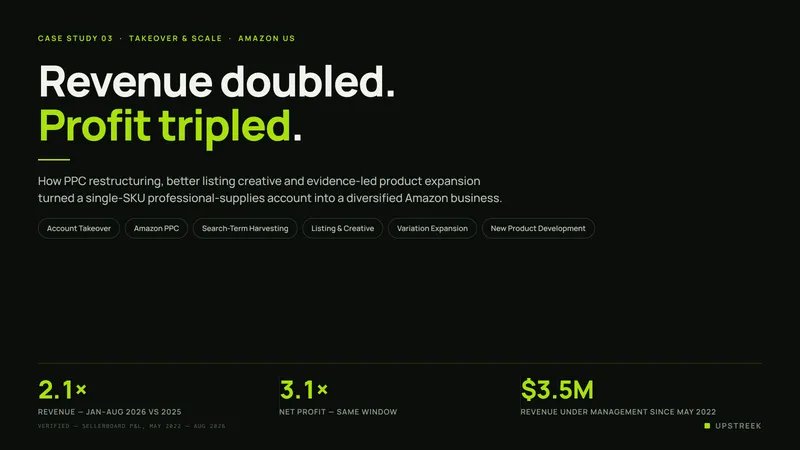
2.1×

Revenue · Jan–Aug 2026 vs the same months in 2025

3.1×

Net profit · same window

$3.5M

Revenue under management · since May 2022

The starting point

This was not a launch. The brand was already selling an established professional-supplies product on Amazon when we took the account on, with real sales history behind it. But almost all of the revenue came from one SKU, the advertising carried more waste than it should have, and the catalogue had never been developed past its original product. The brief was to fix what was already there, then find the account’s next source of growth. Available performance data begins in May 2022.

From pressure to progress

A sequence of decisions, turning points, and proof.

  1. The Starting Position

    In its first eight months in the data the account averaged $35,435 a month on around 1,500 units. Solid, but static — and concentrated. One product carried the revenue, which meant one ranking slip or one stockout could take most of it away. The listing was underselling the product to buyers who could not tell from the images what they were actually getting. And the advertising was spending against search terms that were never going to convert for a product like this.

  2. The Listing and Creative Challenge

    This kind of product is bought on specifics: what it is made of, how much protection it gives, how many come in the pack, what it fits, and where it is meant to be used. The original listing left too much of that to be guessed at. We rebuilt the infographics and listing content around those questions, so a shopper could answer them from the image block alone and the differences between variations were obvious rather than buried in the bullets.
  3. Fixing PPC Waste

    Auto campaigns were doing real work — producing sales and surfacing search terms we would not have found on our own — so switching them off was never the plan. The problem was what they spent alongside that: queries that would never convert for this product. We worked the search-term reports, applied negative targeting where it was clearly justified, and pulled spend back to what the data supported, while leaving the discovery function intact. The point was control, not amputation.
  4. Building a Balanced Campaign Structure

    With the waste under control, each campaign type got a job. Auto for discovery and product relevance. Broad for market expansion. Phrase for controlled discovery. Exact for proven, high-intent searches, harvested from terms that had already converted. Exact keywords often carried higher click costs, and the instinct is to drop them — but a high CPC does not make a keyword unprofitable. We judged them on what they returned, bid accordingly, and stopped any one targeting type carrying the whole account.
  5. Expanding the Core Product

    The single-SKU problem needed a catalogue answer as well as an advertising one. We added variations to the core product family so the listing could serve more of the demand already reaching it — more choice at the point where shoppers were already landing, and less of the account’s revenue riding on one child ASIN.
  6. Testing New Categories — and Stopping One

    Diversifying an account means launching things that might not work. We tested a new product line in an adjacent category. It did not perform to target, and rather than keep funding it because it already existed, we read the result early and stopped putting capital behind it. That decision is the part worth copying. The cost of an honest stop is one launch. The cost of defending a launch you have already paid for is every quarter after it.
  7. Finding Growth in a Second Category

    The next test went differently. The second category found demand quickly and became a real engine for the account rather than a side line. From early 2025 the numbers change shape: monthly revenue moves from $45,740 in January 2025 to $178,539 in August 2026. In the first eight months of 2026 the account took $1,245,284 — more than the whole of 2025 — and it had stopped being a single-product business with a few others attached.
  8. The Outcome

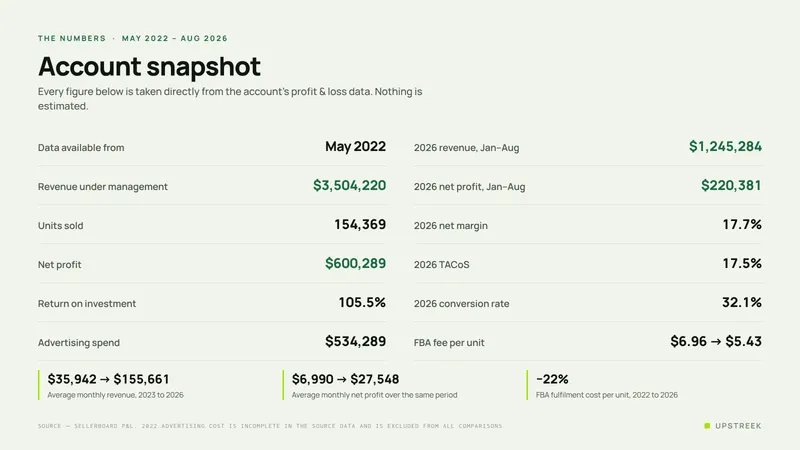
    Scaling cost margin before it gave it back. As advertising scaled through 2023 to 2025, net margin fell from the high teens to 11.4% — the price of buying growth. In 2026 it returned: $1,245,284 in revenue and $220,381 in net profit across eight months, 2.1× the revenue and 3.1× the profit of the same months in 2025, at a 17.7% margin. Average monthly revenue has gone from $35,942 in 2023 to $155,661; average monthly profit from $6,990 to $27,548.

What We Learned

Three things. An established brand with steady sales can still be badly under-optimised — “not failing” is not the same as “nothing left on the table”. Auto campaigns should be controlled rather than switched off, and a high CPC on an exact keyword is a reason to check its profitability, not to abandon it. And diversification has to be evidence-led: we launched one product line that did not work and one that did, and what mattered was reading both results honestly and moving the money to where the demand actually was.
Performance visuals

Case study cover slide for an anonymised professional-supplies brand showing revenue up 2.1x, net profit up 3.1x year on year, and $3.5M of revenue under management since May 2022.
Account snapshot showing data from May 2022, $3,504,220 revenue under management, 154,369 units, $600,289 net profit, 105.5% ROI, $534,289 ad spend, and 2026 figures of $1,245,284 revenue at a 17.7% margin.

Sitting on an account that has stopped growing?

An established brand with steady sales is often the easiest thing to improve — the traffic is already there, the history is already there, and the waste is usually hiding in plain sight. Send us the account and we will tell you honestly what we can see.